Showing posts with label Activities. Show all posts

Tuesday, March 28, 2017

Motivating Students Lesson

State testing is right around the corner. Am I the only one with students who check out after spring break?!? 
Due to this checking out coupled with upcoming testing, this month's lessons focus on being motivated and setting goals! This lesson goes hand in hand with last month's lesson on careers, which I refer to often in these lessons (especially my 4th-6th graders).

For my K-1 students, I do a lesson and activity much like I did last year. See here.

For 2-3 We talk about setting SMART goals and go through several examples. This does go over several of their heads, but I believe it's important for them to at least hear it even if the understanding comes later. Many of them do catch on and do well!
Image result for SMART goals
For my older ones, we do the same thing, learn about and practice setting SMART goals. But before we do that, I try to motivate them to not give up and to work hard. I use a power point that has several people that had to work very hard to get where they are. These are people who failed or faced obstacles. There's a few they all know and some they don't. We talk about how it is okay to fail, but not to give up. Many of my students will have to work hard to have a better life, so I want to expose them to people who made it.

The powerpoint for older students and all the SMART goal sheets I use are available in my TPT store. There is also a discounted bundle with both!


Monday, February 27, 2017

Career/Job Lessons

I started a new round of lessons recently. This round the topic is careers! In Georgia, we have certain lessons on career clusters that are required each year. Our teachers teach these, so I've been unsure of what to do for a career lesson that won't interfere with the state mandated lessons.
I decided to focus on their jobs right now, coming to school and doing their best. We talk a little about different types of careers, but the focus is on what they are learning right now will help them get to be whatever they decide they want to be.

Image result for when I grow up weird alFor my youngest ones, I read When I Grow Up by Al Yankovic. In this book, Billy is telling his class all about ALL the things he wants to be when he grows up, which is a lot of things. It is a really cute book and my students love it. I allow them to color a picture with what they want to be when they grow up.

For my 2nd and 3rd graders, I also read the book and we play career bingo. They love it! I got my bingo boards from here. She has another version too that I have not used yet, which you can get here


For my older students, 4th-6th, I want them to start connecting education to standard of living, so we do a lesson on careers and money. Each student get a randomly assigned job that is paired with the level of education needed. The more education you have, the more money you earn. I included some trade school jobs to emphasize that not all students may go to college, but some sort of continuing education will be needed. They they get to choose what they want in the form of bills. Do they want an apartment or a house? Do they want to have a nice cable package or internet or a cell phone? Would they like to go out to eat a lot? What about going to a movie or a concert once in a while? It really helps them see that luxuries aren't something those without a diploma often get to have. I've included a few snippets from the lesson below. 


Click here to get an editable version of the Careers and Money lesson, and here for a non-editable version (that's a couple of dollars cheaper!). The lesson includes the worksheets, the power point, and the job cards!

What tools do you use for career lessons? What activities do your students love?

Monday, February 13, 2017

NSCW 2017

Last week was a very crazy week for this counselor, but I did celebrate National School Counseling Week! First, I hung posters up in the hall for the week with reminders of what a school counselor does and what I can help with.
I also wanted to do something fun and special for the staff of my school. They are wonderful and very supportive of my work. I saw this on Pinterest and fell in love with the idea!

My teachers are very competitive with each other, so this was perfect for them. They really got into it and I had several guesses written down. For a prize, I donated a bottle of hand sanitizer to the winner for their room/area that was filled with legos. You can never have enough hand sanitizer, especially with all the sickness going around right now!

All of my activities and posters were Lego themed, and were centered around the image below. I found this image online and it is not any creation of my own and I do not own any rights to it. I printed this image out and put it on the hand sanitizer bottle one of my teachers won! 


Tuesday, October 11, 2016

Intros Pt. 2 16-17

Whew! I have been a busy school counselor! I have been working through the remainder of my intro lessons for this year and trying to get to as many students as I can before my maternity leave begins. I have about 2.5 weeks left!

Due to my pregnant state, I have taken my intro lessons easier this year. See this post for my younger lesson. For my 2nd-6th graders, I've used the same power point with a developmentally appropriate activity to go along with it. It uses true/false statements to review what a school counselor does. Many of the statements are true, but some are false, and some are just not things a counselor helps with in most cases. 


I've been pleased to note how much my students remember about what a school counselor does! Last year was like starting fresh with my students. My predecessor did little to no classroom lessons, so many had no idea who she was or what she did. I started out aiming to fix that. This year I thought they might need to be retaught, but many of them remembered all the ways I can help!

I love doing an intro lesson as my first lesson, though. It gives new students the opportunity to learn what I do and it never hurts to review with my returning students. My favorite part of these lessons, though, is the activity. I give the students an opportunity to tell me what they'd like to talk to me about. While I get a lot of "no" written, cute pictures, and genuine love, I do get many requests to talk about things. Often things they really need to process that I had no idea about! For the older ones, I also give them a chance to tell me what they need this year. What do they hope to learn? What do they need to be successful? 

How do you like to start off the year at your school? What lessons/topics work well for your students?

Check out my TPT store for this power point as well as the developmentally appropriate activity sheet where the students tell me what they want to talk about. 

Monday, May 23, 2016

Respect: 4-6

Whew! What a crazy month this has been! As we wrap up the school year in my county, I wanted to do one last post for this year's lessons. I made a previous post about respect with my K-3 classes.

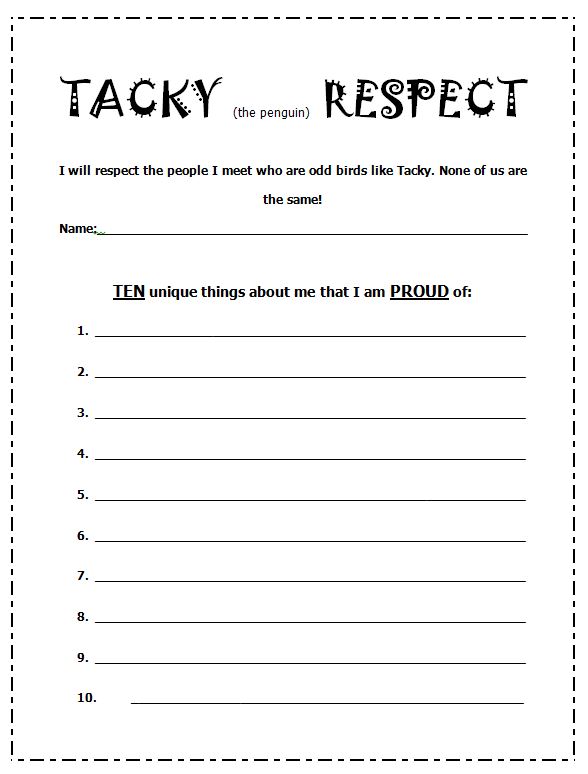
Originally I had planned to do a superhero themed respect lesson, But I love Tacky the Penguin so much, I decided last minute to adapt this lesson for my older kids! It ended up being a pretty fun lesson talking about how we are all different and how we need to respect the differences in others. 

Image result for respect diversity

First, I start off with a game. My kids love games! It is an adapted version of Simon Says in which only some kids get to do each one each time. I'll have students with green eyes raise their hands or have students whose favorite sport is basketball put their hand on the head. I mix up my directions, so I also tell them they have to be listening to what I'm telling them to do in addition to whether the current topic applies to them. The point of this at the end is that we are all different. I ask my students what they noticed during our game, and nearly every class manages to say how we are all different with little prompting. 


Image result for tacky the penguinNext I read Tacky. My older students do enjoy being read to. They are more attentive during my reading than during any other time. After I read Tacky, we talk about how different Tacky was. I then ask them who thinks Tacky got picked on by his friends because he was weird or different. Most students believe he would have been. We then discuss how we shouldn't do that and I remind them how different we all were in our game. I tell them they will meet some people who are oddbirds like Tacky. They'll meet some weird people. They may like these people or the way they do things, but that does NOT mean they can treat these Tacky-like people poorly because they are different or be cruel to them because they are a little odd. I tell them I expect them to be respectful to these people.

We then switch gears and talk about how if everyone is different, they are the only them the world has. No one is like them. We talk about the word unique and what things make us unique. Their activity is a sheet with ten places for them to write unique things about themselves. I tell them these things need to be things they are proud of and that they cannot be about things they own, except for pets. I give them examples to give them some ideas. I suggest hair, eye color, hobbies, sports they play, cool abilities they have (juggling, spinning a basketball on their finger, doing a back bend, being double jointed, etc.), being short or tall, wearing glasses, having freckles, etc. I give them a personal example of still being able to buy shoes in the children's department. I tell them that I know that's somewhat weird, but it makes me unique and I'm proud of it. I think if you can give them a person example like that it really helps encourage them to think about theirs. Several of mine light up when I talk about my weird little feet! I usually have one ask if I'll take them up, which I don't. I don't need their sheets, and I want my students to remember things they are proud of about themselves. 

You can get my Tacky worksheet AND a copy of the Simon Says game here!

Wednesday, January 13, 2016

Simon's Hook

Wow I have been busy since returning to school! Attendance monitoring is a part of my job, and December attendance threw me through a loop this month. I'm finally starting to rise out of the ocean of phone calls and paperwork I do to monitor attendance. While I've been wading through attendance, I have been teaching lessons. This month my lessons are about conflict resolution. For my little ones (K-3), I am focusing on teasing. 


I use two videos based on the book Simon's Hook by Karen Gedig Burnett. The book and the lesson are very good, but the book has some parts that are very busy and can be hard for little ones to grasp. The author helped make these videos, so they are nearly verbatim from the book. You can find the links to the videos at the end of this post.


I start out my lesson by reviewing what we have already talked about this year. Then I explain that we are watching a video based on this book. I always take the book because sometimes technology fails! I tell them they are going to meet Simon, and Simon has a problem: he is being teased at school. We talk about what teasing means to make sure they understand. I then tell him he is going to talk to Grandma Rose and that she will help him solve this problem. Then we watch the first video.
After the first video, I reiterate that when people tease, they want to see someone get upset; they want to see someone get sad or mad and react that way. I tell them to pay close attention as Grandma Rose teaches Simon five ways to handle teasing. Then we watch the second part. After it finishes we review the five strategies. 
To finish our time, I give them each a fish to color, and for the older ones, I ask them to write their favorite strategy in their fish, which one they plan to use next time they get teased.

You can download the fish I use for my lesson for FREE in my TPT store!

Video #1: https://www.youtube.com/watch?v=DB6BnCYcG-4


Monday, December 14, 2015

Jenga

I have some students who are dealing with varying issues, including sadness/depression and anxiety (especially about tests) that I am checking in with as regularly as I can. I wanted to use Jenga as a part of my work with them. I have seen where other counselors write questions on the Jenga game. I wanted to have a multipurpose Jenga that wasn't written on so I could use it for many things. So I set out to find some sets of questions that were already made!


There weren't a whole lot out there I found. However, I did find one wonderful set on TPT! It has five sets of questions that you could ask while playing any game, including Jenga. Check it out here. This is NOT one of my products on TPT, but I think this is a great resource. There are two pages full of questions for each of the five topics. I love this because I don't have to take the time to compile my own set of questions for any of these topics, and I can use my Jenga game for many problems kids have instead of just one.

I wasn't looking for a "get to know you" version of this, but in my search, I found one of those too! Here is a free version of these questions. This would be great for a small group or with a shy child.

-------------------------

Do you ever use Jenga in your counseling program? Let me know what that looks like for you!

Friday, November 6, 2015

Anger

Like I always tell my students, we all get sad and mad, but sometimes we need help dealing with our sad and mad feelings. 
Here are a few strategies I use for angry kiddos:

  • I use pinwheels. You have no choice but to breathe deep when blowing a pinwheel. And my pin wheels are like industrial strength! I found these on clearance at Target at the end of the summer. Sometimes I even struggle to blow them! 
  • I use beads and pipe cleaners to make a countdown tool. Counting down from ten, or even up to 10, can help them get a hold of their strong emotions. This is a tangible way for them to count. 


  • I have a pool noodle I cut into small pieces to use as a stress ball, first mentioned here. Such a cheap and easy way to get a stress ball! Sometimes it even sounds like bubble wrap to me!

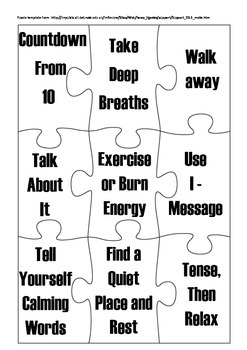
  • I use the anger management puzzle. This puzzle has nine different strategies for kids to use to calm down when they are angry. The file will also come with instructions and an explanation for each strategy. It might be good the first time to play with the pieces turned over and talk about them one by one as the student flips them over. Or you could discuss them as they assemble it. I like to ask which is their favorite and what makes it their favorite.
Anger Calm Down Strategies Puzzle

These are my go-to favorite anger strategies. What are yours? What do you use with your students?

Thursday, November 5, 2015

Bucket Filling Activities!

As I mentioned in my last post, I love the book about being a bucket filler. I know many teachers already use this book in their classrooms, but I use it as a kindness lesson for all of my kids K-6. As promised, here are the activities I do with them after reading the book: 

1. For kindergarten, writing can sometimes be a challenge for them. So, I give them the page below that allows them to draw a picture of how they could fill a bucket. I encourage them to think specifically about something they could do today. Sometimes students this age struggle with the concept of an invisible bucket, so I always clarify they know what invisible means. After reading the book, we do the drawing. I always follow up telling them to draw one way they will fill a bucket today by saying to draw something nice or helpful they can do for another today.  


2. For first-third, I have two writing activities. Which one I use depends on the level of the kids in each class. Sometimes first graders struggle with a complete sentence, so I have a sentence starter version for these guys where they can complete the sentence to say how they will fill a bucket today and then draw a picture of it.If they are able, I like to give them the page with just sentence lines on it. I try to encourage their academic skills whenever I can, so I do prefer to have them write the sentence themselves if possible. This page also has a spot for drawing pictures. I wish I had taken some pictures of some of the drawings I've seen so far! Some of them really are fantastic!


3. For fourth through sixth, I like to have them fill buckets right there in class! They use these cards to say something bucket filling to a friend. I always proof these before returning them to the teachers. Sometimes they say hurtful things
meaning well. I let them do as many as they have time for or want to do. Many of them have great ideas! 
For this lesson, I also try to teach about good compliments. They know saying someone's shirt is pretty is a compliment, but I encourage them to focus on something about the person. What is cool about them as a person? What thing is that person good at that they respect or admire? What do they value in the other person? Superficial compliments are good, but this kind of compliment is even better I think. 


All of these activity pages are available in a pack you can find in my TPT store. :) 


So, what do you think? Will this work with your students? Have you done bucket filling before? If so, what are your activity ideas?